%20Background%20Remov.png)
South Bay Wildflower Trails: Best Spots for Spring Blooms
Updated: Jul 3
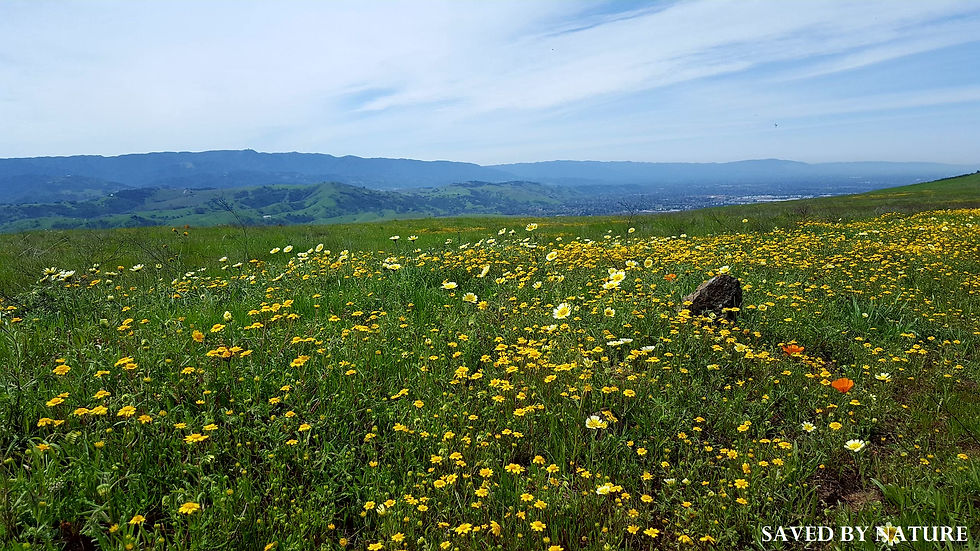
The South Bay offers some of California's most spectacular wildflower displays each spring. The best South Bay wildflower trails include Santa Teresa County Park, Rancho San Vicente/Calero County Park, Coyote Lake/Harvey Bear Ranch County Park, and Coyote Ridge Open Space Preserve — all featuring rare serpentine soil ecosystems that support unique native blooms.
Why the South Bay Is a Wildflower Destination
The Santa Clara Valley region hosts one of California's most biodiverse wildflower landscapes, largely thanks to its unusual serpentine soil. Derived from California's state rock, serpentinite, this soil is naturally low in nitrogen, phosphorus, and potassium — conditions that would challenge most plants. Yet native wildflowers have evolved over millennia to thrive here, producing dense, colorful displays found nowhere else on Earth.
Spring blooms typically peak between February and May, with lower-elevation poppies and goldfields arriving first, followed by rare serpentine specialists at higher elevations. Santa Clara County alone supports over 200 native wildflower species across its parks and open space preserves.
Best South Bay Wildflower Trails by Park
Santa Teresa County Park — Stile Ranch-Mine-Fortini Trail Loop (2.4 Miles)
Santa Teresa County Park delivers one of the most visually dramatic wildflower experiences in the South Bay. The 2.4-mile Stile Ranch-Mine-Fortini Loop begins in the Almaden Valley off San Vicente Avenue, where serpentine switchbacks climb a steep hillside blanketed in California poppies so dense they turn the entire slope a vivid orange.

What you'll see on this trail:
Along the switchbacks, look for chia, black sage, seep spring monkeyflowers, serpentine sunflowers, and Mt. Hamilton thistles growing along a hillside seep. The first valley reveals serpentine linanthus, shooting stars, and California buttercups blanketing the slopes. A second set of switchbacks passes through California gilia, while the descent into the second valley brings scattered royal larkspur, cream sacs, and lupines.

Later in the season, the trail rewards patient visitors with common yarrow, golden yarrow, wiry snapdragon, wavyleaf soaproot, endangered Santa Clara Valley dudleya, ithuriel's spears, goldfields, tidy-tips, bee plants, and — toward season's end — striking mariposa lilies.
The Stile Ranch Trail connects to the Mine Trail, which climbs briefly over a poppy-and-phacelia-lined hill before joining the relatively flat Fortini Trail as it descends back into Almaden Valley.

Rancho San Vicente / Calero County Park — Lisa Killough Trail to Lisa's Lookout (5.4 Miles Out-and-Back)
The 966-acre Rancho San Vicente, the newest addition to the 4,471-acre Calero County Park, contains 506 acres of serpentine soil — one of the highest concentrations in Santa Clara County. This creates extraordinary wildflower diversity along the 5.4-mile out-and-back Lisa Killough Trail to Lisa's Lookout, which can also be extended into an 8.7-mile loop using the Cottle Trail.

What you'll see on this trail:
The trail begins by wrapping around a serpentine-covered hill rich with California poppies, cream cups, Douglas' silverpuffs, popcorn flowers, owl's clover, bird's-eye gilia, California gilia, muilla, and the endangered Santa Clara Valley dudleya.
Further along, hillsides transform into carpets of bright yellow goldfields — one of the most photogenic sights in the South Bay.

The route passes through a manzanita forest lined with monolopia (tall, goldfield-like blooms), reaches a bench overlooking New Almaden and Almaden Quicksilver County Park, then winds through a grassy valley before crossing a bridge over a creek where rare Mt. Hamilton thistle grows.
A shady California bay forest with miner's lettuce carpeting the understory leads to Lisa's Lookout — a picnic area with sweeping views of Calero County Park and Rancho Canada del Oro Open Space Preserve.
The Lisa Killough Trail continues an additional 2.2 miles to the Cottle Trail, which runs along Calero Reservoir for 2.8 miles back to the trailhead — a rewarding full-loop option for stronger hikers.

Coyote Lake / Harvey Bear Ranch County Park — Calaveras-Coyote Ridge-Harvey Bear Trail Loop (6.2 Miles)
Covering 6,695 acres including the 449-acre Coyote Lake, this expansive park offers 35 miles of multi-use trails for hiking, biking, and horseback riding. Its wildflower centerpiece is the serpentine area along the Calaveras Trail — one of the few remaining habitats in the world for the threatened Bay checkerspot butterfly.

What you'll see on this trail:
The Calaveras Trail, accessed via the Harvey Bear Trail above Coyote Lake Dam, opens with shooting stars and California buttercups before passing fields of scattered lupines, poppies, johnny-jump-ups, blue-eyed grass, fiddlenecks, and baby stars with views of Coyote Lake.
The serpentine zone intensifies the display dramatically — hills become densely carpeted with goldfields, poppies, butter-and-eggs, tidy-tips, cream cups, jeweled onions, red maids, and dwarf plantain.
The dwarf plantain here is critical habitat for the Bay checkerspot butterfly (Euphydryas editha bayensis), a threatened species that survives in only a handful of locations worldwide. Spring visits may reward you with sightings of this striking orange-and-black butterfly nectaring among the blooms.

Continuing to the Coyote Ridge Trail provides ridgeline views of Coyote Lake to the east and Gilroy/Morgan Hill to the west, with lupines, fiddlenecks, and poppies lining the path.
The Harvey Bear Trail returns to the dam, with an optional side trip on the hiking-only Ed Wilson Trail to the park's highest northern section, home to California milkweed and the rare big-scale balsamroot.

Coyote Ridge Open Space Preserve — The Crown Jewel of South Bay Wildflower Hikes
The 1,859-acre Coyote Ridge Open Space Preserve in the Diablo Range foothills is widely considered the most spectacular wildflower destination in the South Bay — and one of the finest serpentine wildflower sites in all of California. Sitting above Coyote Valley with sweeping views of the Santa Cruz Mountains, it's a destination that rewards every visit.
Trail options:
Access varies by season and trail type. The preserve offers a strenuous naturalist-guided hike of approximately 7.5 miles round-trip, as well as a lower area of roughly 2.5 miles of accessible trail — check the 👉🏻Santa Clara Valley Open Space Authority website for current access dates and registration requirements, as this preserve manages visitor access to protect its sensitive habitat.

What you'll see:
Watch for seeps throughout the property where seep spring monkeyflowers and endemic Mt. Hamilton thistles thrive.
An insider tip: red maids appear closed in the cooler morning hours but open as the day warms — what looks like bare ground on your hike in becomes a bloom-covered landscape on your hike out, just like the California poppies. The exceptionally rare fragrant fritillary (Fritillaria liliacea) blooms here for roughly three weeks annually, making precise timing rewarding for dedicated wildflower enthusiasts.

Look out for the "Yellow Brick Road" — a spectacular corridor of goldfields blanketing the trail through the preserve.

The preserve overlooks San Felipe Ranch — a 28,539-acre property (roughly the size of San Francisco) purchased in 1954 by Silicon Valley pioneers Bill Hewlett and David Packard, now owned by the Nature Conservancy. From the ridgeline, identify Santa Clara County's highest peak, Copernicus Peak (4,360'), to the left. Looking west, spot the Santa Cruz Mountains' highest peak, Loma Prieta (3,790'), Mt. Umunhum (3,488'), and the Santa Teresa Foothills.

Keep an eye out for tule elk, burrowing owls, coyotes, and western meadowlarks — this preserve offers exceptional wildlife viewing alongside its floral spectacle.
The Science Behind South Bay's Wildflower Diversity
What makes these South Bay wildflower trails exceptional is not just the density of blooms — it's the ecological rarity of the serpentine soil ecosystem that supports them. Serpentine soil, derived from California's state rock serpentinite, lacks the nitrogen, phosphorus, and potassium (N-P-K) that most plants need to survive. Over thousands of years, South Bay native wildflowers evolved highly specialized adaptations to thrive in these challenging conditions.
This evolutionary pressure created a unique flora found nowhere else on Earth. Species like the endangered Santa Clara Valley dudleya, the rare fragrant fritillary, and the endemic Mt. Hamilton thistle exist in only a handful of locations globally. The serpentine grasslands that support these species are considered a biodiversity hotspot, with conservation scientists treating them as irreplaceable ecological assets.

The connection between serpentine soil and wildflower displays also explains why South Bay blooms can be more reliable and visually concentrated than the broader California super blooms that depend on rainfall patterns. Even in average rainfall years, South Bay serpentine wildflowers produce impressive displays — making this region a consistent destination for wildflower enthusiasts.
Explore these rare ecosystems in depth through Saved By Nature's 👉🏻 outdoor education programs, where naturalist instructors bring the science of serpentine habitats and native plant ecology to life in the field.
Frequently Asked Questions About South Bay Wildflower Trails
When is the best time to see wildflowers in the South Bay?
Peak wildflower season in the South Bay typically runs from late February through early May. Lower-elevation parks like Santa Teresa County Park tend to peak in March, while higher-elevation serpentine preserves like Coyote Ridge see peak blooms in April. Timing varies each year based on winter rainfall, with wetter years producing more dramatic displays.
What is serpentine soil and why does it matter for wildflowers?
Serpentine soil is derived from serpentinite, California's state rock. It contains unusually high levels of magnesium and heavy metals while lacking the nitrogen, phosphorus, and potassium most plants need to thrive. Only specialized native wildflowers have evolved to survive in this soil — creating unique, highly localized plant communities found nowhere else. The South Bay contains some of California's largest and most intact serpentine grassland ecosystems.
What is the Bay checkerspot butterfly and where can I see it?
The Bay checkerspot butterfly (Euphydryas editha bayensis) is a threatened subspecies that depends on serpentine grasslands in Santa Clara County. Its caterpillars feed exclusively on dwarf plantain and owl's clover — plants that grow primarily on serpentine soil. Coyote Lake/Harvey Bear Ranch County Park and Coyote Ridge Open Space Preserve are among the few remaining locations where this butterfly survives. Peak sighting season is March through May.
Are South Bay wildflower trails dog-friendly?
Trail rules vary by park. Santa Teresa County Park and Coyote Lake/Harvey Bear Ranch County Park generally allow leashed dogs on trails. Coyote Ridge Open Space Preserve has more restricted access rules to protect sensitive habitat — always check current regulations with the Santa Clara Valley Open Space Authority before visiting.
Do I need a permit to visit Coyote Ridge Open Space Preserve?
Coyote Ridge Open Space Preserve manages access to protect its rare serpentine habitat. Access requirements including registration, guided tour options, and open access days change seasonally. Check the Santa 👉🏻 Clara Valley Open Space Authority website for current access information before planning your visit.
What wildflowers are unique to the South Bay?
Several wildflower species are endemic or rare to the South Bay serpentine ecosystem, including the endangered Santa Clara Valley dudleya (Dudleya setchellii), the rare fragrant fritillary (Fritillaria liliacea), the endemic Mt. Hamilton thistle (Cirsium fontinale var. campylon), and big-scale balsamroot (Balsamorhiza macrolepis). These species make the South Bay one of California's most botanically significant wildflower destinations.
Discover South Bay Wildflowers With Expert Naturalist Guides
Spring wildflower season in the South Bay is one of the Bay Area's most remarkable natural spectacles — and experiencing it alongside a knowledgeable naturalist transforms a pleasant hike into a genuine ecological education. Understanding the serpentine soil science, recognizing rare species, and learning which blooms support threatened wildlife like the Bay checkerspot butterfly gives every wildflower walk deeper meaning and lasting impact.
Experience this connection firsthand through Saved By Nature's 👉🏻 naturalist-led outdoor education programs, designed for all ages and experience levels. Our guides bring scientific knowledge and conservation insight to every trail. Check our 👉🏻 upcoming nature walks to join guided wildflower explorations throughout South Bay parks and open space preserves this spring.


Written & Photographed by Richard Tejeda
Founder & Executive Director of Saved By Nature

SEO, GEO, & Content Optimization by Lyle van Tonder
Digital Marketing Specialist | Web Developer | SBN Board Member


Comments